How to Manage Crypto Assets in 2025
A clear, up-to-date guide on how to manage crypto assets in 2025—custody, taxes, ETFs, security, and risk—so you can invest with confidence.
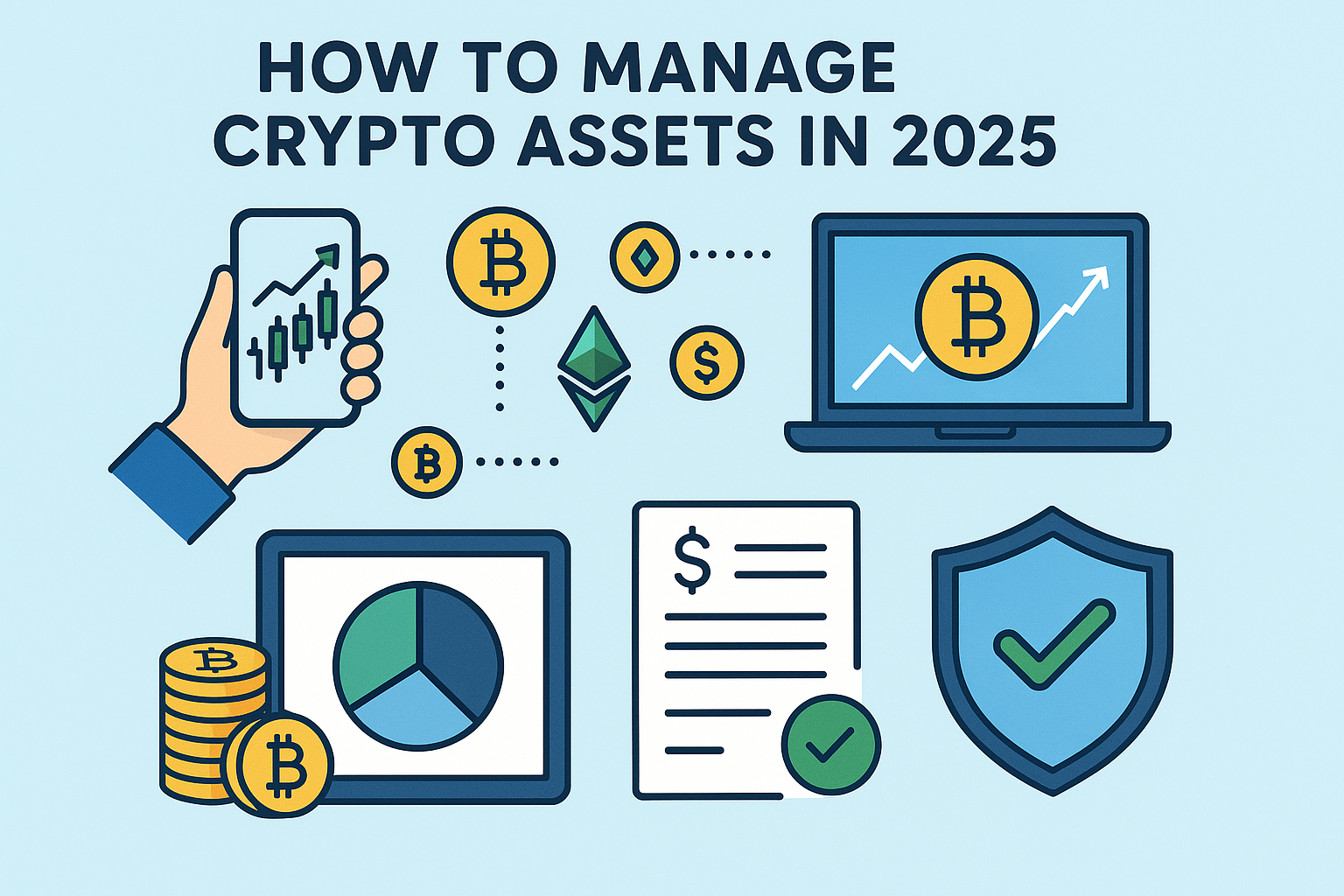
Managing digital wealth isn’t just about buying coins and hoping for the best. In 2025, the crypto market sits at the intersection of tighter regulation, easier access via mainstream investment products, and better security tooling. That means you can build a safer, more brilliant strategy—if you focus on the right moves. In this guide to how to manage crypto assets in 2025, you’ll learn how to choose the right custody model, structure a diversified portfolio, plug tax leaks, evaluate exchanges, and harden your security posture without turning your life into a full-time job.
Along the way, we’ll incorporate the latest regulatory milestones—such as U.S. tax reporting changes, the EU’s MiCA regime, and the ETF landscape—so your plan is aligned with how the rules actually work today. The goal is practical clarity: understand your options, pick what fits your situation, and execute with discipline.
The 2025 landscape: what actually changed—and why it matters
The story of the last 18 months is simple: crypto moved further into the regulated, mainstream investing stack. In the U.S., the SEC approved spot Bitcoin ETPs in January 2024, followed by spot Ethereum ETFs starting to trade in July 2024, making exposure possible inside many brokerage accounts rather than only on crypto exchanges.
On the tax front, the IRS finalized regulations for broker reporting of digital assets. Beginning with transactions on or after January 1, 2025, brokers must issue the new Form 1099-DA, which reports sales and certain exchanges of digital assets, along with additional transitional guidance for implementation. For investors, the practical takeaway is that taxable events are now more visible to the IRS and mismatches may trigger notices.
In the EU, the MiCA regulation began phasing in from 2024 to 2025, establishing standard rules for stablecoins and most crypto-asset service providers across the European Economic Area. For users, this means clearer disclosures, prudential requirements for issuers, and a more consistent licensing framework across member states.
U.S. banking policy also evolved. In March 2025, the FDIC rescinded its prior notification requirement and clarified that FDIC-supervised banks may engage in permissible crypto activities provided they manage risks appropriately—an incremental but meaningful signal that traditional finance and digital assets will continue to converge.
All of this changes how you can manage crypto: you have more compliant on-ramps, clearer tax obligations, and better choices about custody and access.
Decide your custody model first
Your custody decision drives everything else—fees, convenience, risk, even your estate plan. Think of custody on a spectrum:
Self-custody with hardware or MPC wallets
Self-custody means you control your keys. For many, that’s a hardware wallet with an offline recovery phrase. NIST’s key-management guidance underscores why disciplined key handling—generation, storage, rotation, and recovery—matters as much as the device you choose. Treat keys like crown jewels, with policy and process, not just gadgets.
In 2025, MPC (multi-party computation) wallets are expected to become popular among both individuals and institutions, as they split signing authority into shares, ensuring that no single device or person ever holds the entire private key. Properly implemented, MPC can enhance operational flexibility (e.g., replacing a compromised device without requiring a rotation of every address) while maintaining strong security.
If you choose seed-phrase-based wallets, back up the phrase in a durable, offline format and test recovery on a “dry-run” wallet. Fire and water-resistant metal backups are widely recommended precisely because the recovery phrase—not the hardware device—is your ultimate lifeline.
Custodial solutions and brokerages
Custodial platforms—exchanges, prime brokers, or qualified custodians—hold assets for you. The benefit is convenience and integrated services (trading, staking, fiat on-ramps). The trade-off is counterparty risk. If you use a custodian, prefer entities that are subject to robust supervision and have clear solvency disclosures. In 2025, you’ll see more banks offering white-glove crypto custody under clarified FDIC guidance, which may fit investors who need institutional reporting, segregation of duties, and audit trails.
ETF wrappers
For investors who prefer not to manage their own wallets, spot Bitcoin and Ethereum ETFs allow you to gain price exposure in standard brokerage accounts and retirement plans. You won’t control on-chain assets or use DeFi, but you’ll simplify record-keeping and reduce operational risk. These products started in 2024 and have become a core access route for many diversified portfolios.
Action step: Select the model that aligns with your goals and constraints. If you need on-chain utility (DeFi, NFTs, direct staking), self-custody or institutional custody is essential. If you only want exposure to price with minimal overhead, ETFs can be sufficient.
Build a resilient allocation: what to own and why
A durable crypto plan in 2025 is barbell-shaped: a core that tracks the market’s biggest networks, plus a selectively sized satellite for opportunities.
Core exposure: large-cap networks and ETFs
Keep your core simple. For many, that means a mix of BTC and ETH, either self-custodied or via ETFs, sized according to your risk tolerance and total portfolio. The case for core exposure is that liquidity, infrastructure, and regulatory clarity are most substantial in this area.
Satellite exposure: selective themes
Beyond the core, you might add carefully sized positions in sectors you understand—scalable L2s, real-world-asset protocols, or privacy infrastructure. Keep sizing disciplined. If you’re in the EU, verify the provider’s MiCA status and disclosures. In the U.S., pay attention to whether access is provided via regulated products. MiCA’s uniform regime aims to reduce jurisdiction shopping and improve comparability across providers—use that to your advantage.
Stablecoins for liquidity
If you rely on stablecoins for cash management, prefer those issued with strong attestations and regulatory alignment in your jurisdiction. Under MiCA, stablecoin issuers are subject to explicit reserve and governance rules, which can enhance risk transparency for EU users.
Yield without nasty surprises: staking the right way
Proof-of-stake rewards are enticing, but staking carries real risks: slashing for validator faults or misbehavior, lock-ups that reduce liquidity, and implementation risk if infrastructure isn’t robust. Diversifying stake across multiple, independent operators helps mitigate correlated slashing—a point emphasized in institutional submissions to U.S. regulators. If you use liquid staking tokens (LSTs) for flexibility, remember that they introduce smart-contract and depeg risks in addition to network risk.
In 2025, U.S. commentary from market watchers has noted the SEC’s clarified stance that liquid staking tokens aren’t, by themselves, securities, which reduces legal uncertainty for some platforms offering LSTs. Treat this as helpful—but not a free pass. Policies can evolve, and you still need sound risk controls and tax tracking.
Action step: If you stake, set guardrails. Cap staking allocations, diversify operators, understand unbonding periods, and keep emergency liquidity outside staking positions.
Taxes and reporting: don’t leave money on the table or invite problems
Starting with the 2025 tax year in the U.S., expect crypto brokers to issue Form 1099-DA for certain sales and exchanges. That means the IRS will have third-party data to match against your return, making accurate basis tracking and timely filings even more critical. Even if your platform issues forms, you’re still responsible for capturing every taxable event, including swaps, spending crypto, and staking rewards where applicable.
Action step: Utilize software or professional assistance to reconcile wallets, exchanges, and DeFi—exporting histories quarterly, not just in April. If you’re in the EU, check whether your provider supplies MiCA-aligned statements—standardized reporting can simplify your bookkeeping.
Exchange due diligence: proof-of-reserves is a start, not the finish
After high-profile failures, many exchanges adopted proof-of-reserves (PoR) using Merkle trees to let users verify that on-chain assets back customer balances. This is useful—but incomplete—because PoR typically doesn’t prove liabilities in whole or capture off-balance-sheet obligations. Treat PoR as one element in a broader due diligence checklist that includes regulation, audits, cold-storage practices, and operational history.
Technically, Merkle-tree PoR provides cryptographic inclusion proofs, allowing users to confirm that their balances were included in a verified snapshot; however, solvency requires both reserves and liabilities. The safest approach remains to minimize exchange balances and self-custody what you intend to hold.
Security that scales with you: from “good” to “great”
Establish key hygiene practices that follow NIST-style principles
Good security is procedural. Generate keys offline when possible, store backups redundantly, and rotate credentials on a schedule. NIST’s key-management publications remain the gold standard for thinking about lifecycle, entropy, and algorithm transitions, including the emerging shift to post-quantum cryptography in the years ahead. Even if your wallet abstracts the details, you benefit from policies that mirror these recommendations.
Consider MPC for shared control and business workflows
If you manage assets with a team or need approvals, MPC wallets provide granular policies (e.g., per-transaction limits, geofenced approvals, time-based rules) without exposing a single private key. Institutions are increasingly choosing MPC for its operational flexibility, and it can also be a smart upgrade for power users.
Harden recovery: back up the thing that actually matters
Your recovery phrase—not the device—is the key to your account. Keep the phrase offline, split or sharded if you use advanced schemes, and protected from fire and water. Schedule periodic recovery tests with a spare device to ensure your backup actually works.
Banking bridges and fiat flows: where the rails are going
As banks receive more explicit guidance on crypto custody and related services, expect more bank-grade rails for stablecoin reserves, custody, and settlement. The FDIC’s 2025 letter signals a pragmatic path for supervised institutions to engage in crypto activities without a special “permission slip,” provided risk controls are strong. For investors, this may translate into better fiat ramps, cleaner financial statements, and higher assurance custody choices.
Putting It Together: A One-Page Operating Plan
-
Choose access: ETF for simplicity, self-custody for utility, or institutionally managed custody if you require operational controls.
-
Define allocation: Core BTC/ETH plus a small satellite sleeve for themes you understand, sized to your risk tolerance.
-
Secure the setup: Follow NIST-style key hygiene, adopt MPC if you need shared controls, and harden recovery with tested backups.
-
Yield carefully: If staking, diversify among operators and understand the risks of slashing and liquidity; treat LSTs as helpful but not risk-free.
-
Stay compliant: Track every taxable event and reconcile across wallets and brokers, noting the 1099-DA regime that takes effect from 2025 onward.
-
Audit counterparties: Use PoR as one data point, not the only one; minimize balances on exchanges when not actively trading.
Conclusion
The market is maturing. You have regulated ETFs for clean exposure, MiCA, and other frameworks that reduce policy ambiguity, bank-grade custody options emerging, and security tech that finally matches the stakes. Managing crypto assets in 2025 isn’t about predicting prices—it’s about designing a system you can operate reliably: the right custody, the proper allocation, disciplined security, and zero-surprise taxes. Do that, and you turn volatility into a manageable input rather than an existential threat.
FAQs
Q: Is an ETF better than holding coins directly?
It depends on your goal. If you only want price exposure with easy reporting and no wallet management, spot Bitcoin or Ethereum ETFs are a convenient option. If you need on-chain utility—such as using DeFi, sending payments, or staking on your own—you’ll need direct ownership via self-custody or a qualified custodian.
Q: What’s the most critical security practice for self-custody?
Perfect your recovery process. Please back up your seed phrase offline in a durable format, store redundantly, and test recovery periodically on a spare device so you know it works before you ever need it.
Q: How will U.S. taxes change for crypto in 2025?
Brokers will begin issuing Form 1099-DA for certain digital-asset transactions occurring on or after January 1, 2025. That increases IRS visibility, making accurate basis tracking essential. Maintain thorough records and reconcile transactions across multiple wallets and platforms.
Q: Are exchanges with proof-of-reserves completely safe?
PoR is helpful because it lets users verify that assets exist on-chain, but it often doesn’t prove liabilities or cover off-balance-sheet risks. Use PoR as one input in your due diligence, not the only one, and minimize idle exchange balances.
Q: Is staking worth it in 2025?
It can be, if you understand the trade-offs. Staking rewards compensate you for helping secure a network, but you face risks such as slashing, smart-contract bugs (for liquid staking), and liquidity constraints. Diversifying operators and sizing allocations modestly are sensible safeguards.
See More: SafePal Crypto Wallet Guide Secure, Simple Self-Custody